Showing posts with label Roger Allam. Show all posts

Thursday, 16 January 2014

The Book Thief (2013); drama film review


Spanish poster artwork for the drama film The Book Thief.

Liberating Literature by Linh

The Book Thief is a film adaptation of the Markus Zusak book of the same name, and is quite faithful to the original novel. The film closely mirrors the book’s themes, emotive pull and narrative style, particularly with Death as narrator throughout the film. The story may appear grim at the beginning with Death narrating, yet it appears apt as the film is set during World War II in Nazi Germany with death as a recurring theme. However, the slight difference is the book does not immediately name the narrator as Death, thereby giving the reader opportunities to determine the identity of the narrator based on the narrator’s observations. The film’s opening scene is ambiguous at first, giving the impression that an angel or God is narrating due to overhead scenes of sky and clouds being shown. Within several seconds, the viewer understands it is neither of them.

COMPETITIVE COMPANIONS: Liesel (Sophie Nélisse) finds a true friend in Rudy Steiner (Nico Liersch) in the drama film The Book Thief. Image: Twentieth Century Fox.
The film begins with Death introducing the story and the focus is on the early life of a young German girl named Liesel Meminger (Sophie Nélisse) on a train with her mother (Heike Makatsch) and younger brother (Julian Lehmann). Her brother dies during the train ride and is buried soon after. At her brother’s funeral, the grave digger (Gotthard Lange) drops a book, which Liesel picks up and keeps with her. Liesel’s mother then sends her away for adoption and mysteriously disappears. Liesel’s foster parents are Hans Hubermann (Geoffrey Rush) and his wife Rosa (Emily Watson), who are very poor. Hans discovers Liesel is illiterate and helps her learn to read and write using the basement walls as a giant dictionary for Liesel to write the words she just learnt. The first book Hans teaches Liesel to read is the one she picked up at her brother’s funeral – The Grave Digger’s Handbook.

One of the locals in Liesel’s neighbourhood is a German boy named Rudy Steiner (Nico Liersch) who loves playing soccer and running. He immediately likes Liesel and becomes one of her closest and dearest friends in the film. As the Nazis continue arresting Jews, Hans takes in Max (Ben Schnetzer), a young Jewish man whose father saved Hans’s life in World War I. Liesel and Max become friends as she reads to him in the basement amid the growing danger he faces if the Nazis find him. As World War II intensifies and many more people die, Liesel finds courage, enlightenment and hope in the words found in books.

SHARING STORIES: Liesel (Sophie Nélisse) keeps Max (Ben Schnetzer) company in the basement with books and conversation in the drama film The Book Thief. Image: Twentieth Century Fox.

The Book Thief depicts a balance of cruelty and inhumanity in some scenes and kindness and generosity in others. An example is the archival footage of Jesse Owens winning gold medals at the 1936 summer Olympics in Germany, which may have been included to show Hitler’s chagrin, while being an inspiration for Rudy Steiner to become a faster runner and make Owens his role model for athleticism. The film shows the growing power of Hitler’s influence during the 1930s and1940s, such as the choir of young children singing the German anthem with Nazi flags and swastikas prominently displayed; the book burning scene; Nazi soldiers smashing and destroying property belonging to Jews then beating them in public before arresting them for persecution. These scenes are contrasted with kindness by Hans and Rosa in helping to hide Max from the Nazis thus risking their own lives if Max is captured; Ilsa Hermann forgives Liesel for stealing her books and then lets Liesel read them in the library with her; Hans, Rosa, Liesel and Max having a snowball fight then building a snowman in the basement for Christmas.

BOOK BORROWER: Liesel (Sophie Nélisse) sneaks into the private library of Ilsa Hermann in the drama film The Book Thief. Image: Twentieth Century Fox.
The cast, that includes Australian, British, German and Canadian actors, is excellent, the performances are compelling and the filming in Germany brings an authentic feel to the time when the terrible events occurred. The use of some German words such as ja/yes, und/and, nein/no or dummkopf/stupid person among the English spoken words may seem awkward at first, but viewers will gradually become accustomed to it and understand it adds a sense of authenticity to the setting, people and time of the film’s events.

Sophie Nélisse (Monsieur Lazhar, Pawn Sacrifice) is captivating as Liesel, the protagonist in the film who finds books are a source of comfort and inspiration. Nélisse is convincing as her character discovers how friendships with Hans, Rudy, Max and Ilsa Hermann (Barbara Auer) help her to understand the importance of using words to stimulate good or evil. Liesel feels robbed of so many loved ones in her life that she tells herself “When life robs you, sometimes you have to rob it back.” However, Liesel uses words to maintain friendships, share in her joy of storytelling and to distract her from the oppressive horrors of the war. On the other hand, Hitler uses words to control a nation, influence the minds and hearts of citizens and to persecute.

The pairing of Geoffrey Rush (The Best Offer, Gods of Egypt) and Emily Watson (Molly Moon: The Incredible Hypnotist, Belle) as the Hubermanns is sheer delight, with a mix of nasty name-calling and gestures of love between this dynamic couple; the young Nico Liersch is brilliant as Liesel’s friend Rudy who secretly loves her and eventually gains her trust; Roger Allam (The Iron Lady,The Angels’ Share) is wickedly cynical yet comforting and kind-hearted as Death.

AIR RAID ANGUISH: Rudy (Nico Liersch), Liesel (Sophie Nélisse) and Rosa (Emily Watson) hide with others in a bomb shelter during an air raid in the drama film The Book Thief. Image: Twentieth Century Fox.
The film is beautifully scored by John Williams whose musical compositions have an emotive flow particularly during the traumatic events of Liesel’s life in Nazi Germany. The Book Thief is not a Holocaust film but it does deal with many elements of the human condition using the events of World War II as a backdrop and the characters as a means to link the power of words to do good and triumph over acts of evil and terror. The film has moments of poignancy and sadness, yet is uplifting and joyful, with enough to be on par with the book.

Director: Brian Percival

Writers: Markus Zusak (novel), Michael Petroni (screenplay)

Cast: Sophie Nélisse, Geoffrey Rush, Emily Watson, Nico Liersch, Kirsten Block, Rainer Reiners, Ben Schnetzer, Levin Liam, Barbara Auer, Rainer Bock, Roger Allam, Heike Makatsch, Julian Lehmann, Hildegard Schroedter, Oliver Stowkowski, Carina Wiese, Gotthard Lange

Producers: Redmond Morris, Karen Rosenfelt, Henning Molfenter, Charlie Woebcken, Christoph Fisser, Ken Blancato

Cinematographer: Florian Balhaus

Original Music Composer: John Williams

Film Editor: John Wilson

Production: Simon Elliott (Production Designer), Bill Crutcher (Art Director), Anja Müller (Art Director), Jens Löckmann (Art Director), Mark Rosinski (Set Decorator)

Costume Designer: Anna B. Sheppard

Languages: English and German with English subtitles

Running Time: 2 hours and 15 minutes


Thursday, 4 July 2013

The Iron Lady (2011); biopic drama film review

Poster artwork for the biopic drama film The Iron Lady.

Margaret’s Memories by Linh

The film The Iron Lady is overall an average film and is saved by the brilliant performances of its lead actors Meryl Streep, Jim Broadbent and newcomer Alexandra Roach. Critics have called it the next King’s Speech, but by no means is this film anywhere close to the warmth, poignancy and inspiration of 2011’s Academy Award winner for Best Film. The Iron Lady is a non-linear biopic seen through the eyes of an older Margaret Thatcher whose memories provide the narrative thread of critical points in her personal and political life.  These moments in her life are some of her most infamous and memorable, yet these events (Falklands War, anti-trade unionism, privatisation etc.) are seen in extended flashbacks and have little explanation and lacks connection to her present state.

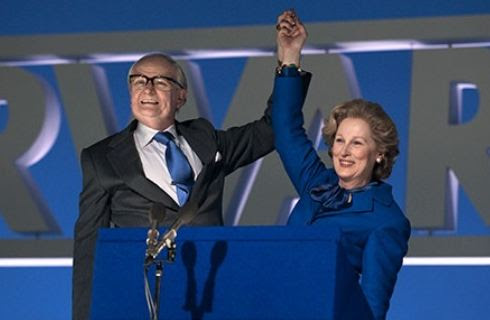
CONSERVATIVE COUPLE: Denis Thatcher (Jim Broadbent) and Margaret Thatcher (Meryl Streep) celebrate Mrs. Thatcher being Britain's first female Prime Minister in the film The Iron Lady. Image: Pathé Films.

The role of Margaret Thatcher is unashamedly Oscar-bait for Meryl Streep, who once again rises to the challenge of convincing mimicry and imitation with her usual excellence in performance and screen presence. Despite Streep’s remarkable resemblance to Mrs. Thatcher, with the help of movie makeup, it is a major fault to use dementia as a means to humanise the former British Prime Minister in order to draw sympathy from viewers. No matter how frail or to what extent she is plagued by mental illness, Mrs. Thatcher will always be seen as a monstrous and fierce political force for refusing to compromise or negotiate with those who disagreed or challenged her views. This unwavering stance has gained Mrs. Thatcher praise as well as criticism that led to division in her party and disunity among her party members and colleagues. During her leadership, women were divided, with those supporting her for being a woman who penetrated the male dominated realm of politics or she was reviled by other women who saw Mrs. Thatcher as more monstrous than humane in dealing with social issues.

PARLIAMENTARY POWER: Margaret Thatcher (Meryl Streep) shows no compromise during parliamentary debates in the film The Iron Lady. Image: Pathé Films.

The film opens with an older Margaret Thatcher (Meryl Streep) twaddling along to the shop to buy milk. She is quietly displeased at what she believes is the high price of milk and complains about it to her husband when she arrives home. Mrs. Thatcher is suffering from symptoms of dementia and she sees her husband Denis (Jim Broadbent) around the house, even though he has been dead for decades. She speaks to him when she is by herself and he responds with jovial quips and silliness. As Mrs. Thatcher tidies up her house, various items trigger memories of her past, bringing on flashbacks from her teenage years, her time before election into the Conservative Party and her glory days until the end of her political career.

Streep is superb as the middle-aged and older Mrs. Thatcher; Jim Broadbent does a sterling job as the ghost of Denis Thatcher; Alexandra Roach is excellent as the young Margaret Roberts and the supporting cast members, comprising of Richard E. Grant, Roger Allam, Anthony Head, Harry Lloyd and Olivia Colman, are commendable in their roles.

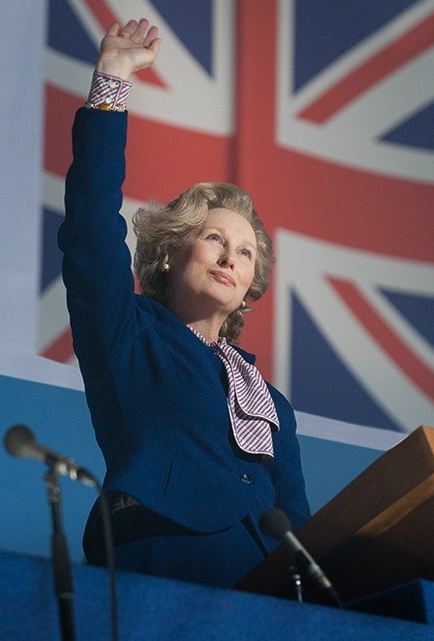
LEADING LADY: Margaret Thatcher (Meryl Streep) prepares for her victory speech in the film The Iron Lady. Image: Pathé Films.

Dementia and other mental illnesses used to “soften up” Mrs. Thatcher is a questionable ploy to gain sympathy for a politician depicted as one who is now left feeling powerless and lonely.  An impairment such as stammering or speech impediment was a sure-fire winning formula for The King’s Speech, but in this instance, mental deterioration is viewed as a blatant attempt for The Iron Lady to gain the sympathy vote from viewers and Academy Award voters. Although it is a wonderful idea to see the effects of dementia on the lives of individuals portrayed onscreen, the film The Iron Lady misuses it for its own purposes (such as for winning awards/sympathy votes). Using dementia in this manner is shameful, yet the producers and director Phyllida Lloyd must be admired for attempting to find a way to humanise Margaret Thatcher in the eyes of many Britons who lived under her regime of social unrest and political turmoil. The Iron Lady helped Meryl Streep win an Academy Award for Best Leading Actress, her third Oscar, and also won for Best Makeup.

The Iron Lady Official Film Trailer (courtesy of Pathé Films):


Director: Phyllida Lloyd

Writer: Abi Morgan (screenplay)

Cast: Meryl Streep, Jim Broadbent, Alexandra Roach, Harry Lloyd, Olivia Colman, Richard E. Grant, Anthony Head, Roger Allam, Nicholas Farrell, Susan Brown, Nick Dunning, Iain Glen, Michael Maloney, Pip Torrens, Angus Wright, Julian Wadham

Producers: Anita Overland, Colleen Woodcock, François Ivernel, Cameron McCracken, Tessa Ross, Adam Kulick Damian Jones

Original Music Composer: Thomas Newman

Cinematographer: Elliot Davis (Director of Photography)

Film Editor: Justine Wright

Production: Simon Elliott (Production Designer), Bill Crutcher, Nick Dent (Art Directors), Annie Gilhooly (Set Decorator)

Costume Designer: Consolata Boyle

Hair and Makeup Designers: Marese Langan, J. Roy Helland, Mark Coulier

Running Time: 1 hour and 45 minutes

Friday, 17 May 2013

Speed Racer (2008); action family film review


Poster artwork for the action family film Speed Racer.

Maximum Visual Velocity by Linh 

Directors and writers Larry and Andy Wachowski of The Matrix Trilogy fame, have given Japanimation an innovative visual twist in their latest film Speed Racer. Speed Racer is the film adaptation of the 1960s cartoon television series, and is a combination of eye-popping visual effects infused with every colour of the spectrum. The CGI of all the racing sequences are supported with a dramatic heartbeat of family values and the fight against corporate corruption.

The film tells of a young race car driver named Speed Racer whose older brother, Rex Racer, was allegedly killed in a cross country race as a result of race fixing. Speed and his family resist the temptation to drive for dodgy businessman and owner of Royalton Industries, EP Arnold Royalton, who consequently threatens Speed with impending poverty and oblivion if he refuses to join the corporate giant. Remaining loyal to his family racing business, Speed teams up with the mysterious Racer X to win the Grand Prix and expose the corrupt cheats in the racing industry.

TEAM EFFORT: Trixie (Christina Ricci), Mom (Susan Sarandon), Pops (John Goodman) and Sparky (Kick Gurry) help rebuild the Mach 5 to get Speed (Emile Hirsch) into the Grand Prix in Speed Racer. Image: Village Roadshow Pictures, Warner Brothers.

The ensemble cast is impressive, yet their talents are mostly wasted as acting prowess takes a back seat to the whizz-bang, optically vibrant imagery on screen. However, all the leading players make a lasting impression and add a special quality to their characters.
Emile Hirsch stars as the baby-faced man-boy, Speed Racer, whose real talents lie behind the wheel of a race car. Hirsch keeps the adrenaline pumping in all his race car scenes amidst the brightly coloured landscapes and video-game style race sequences. All the car-fu (automobile martial arts) in mid-air and off the cliff edge were awe-inspiring and would have any racing fan on the edge of their seat.

Christina Ricci plays Speed’s childhood sweetheart, Trixie, and is his eye-in-the-sky as she keeps watch in her helicopter during his races. More than just a pretty face, Trixie can jostle the throttle and burn the rubber in a race car with the best drivers – much to Speed’s delight. Christina Ricci may not have much to say as Trixie, other than “Cool beans” or “Hubba bubba”, yet she can certainly pack a punch with her fists and kicks butt with her fast legwork.

John Goodman is perfectly cast as the patriarch of the Racer family, Pops Racer, whose skills and talent lies in car building and strategic driving/planning. Pops has been in the racing game for a long time and understands how the greed and corruption in the racing industry ruins lives and breaks up families. John Goodman is wonderfully robust and quick witted as Pops, even cracking jokes faster than Indiana Jones cracks whips. 

Susan Sarandon is the mother of all mothers as Speed’s mum, Mom Racer. Sarandon makes Mom perkier than Jane Jetson, more womanly than Wilma Flinstone and is the emotional glue that keeps the Racer family together in times of trauma and tragedy. Not only is she adept in her pancake making and peanut-butter-and jelly sandwiches artistry, Mom also helps build cars alongside Pops.

Star of television series Lost, Matthew Fox gives a slightly subdued performance as the mysterious Racer X. Perhaps his character’s got something to hide? Fox brings a strong competitive streak to Racer X, who’s most animated in the car racing sequences and really comes alive on the track. 

Other notable performances include British actor Roger Allam as the villainous EP Arnold Royalton whose tantrums are legendary; Australian actor Kick (Christopher) Gurry is hilarious as the Racer family’s sweet and sensitive resident mechanic Sparky; Korean superstar Rain as the reckless and ambitious driver Taejo Togokahn is superbly suited as the ally to Speed and Racer X; Paulie Litt is excellent as Speed’s annoying younger brother Spritle, along with his cheeky pet chimpanzee Chim Chim and a supporting cast of many cultures help highlight the international appeal of motor racing as a sport and passion. 

Speed Racer seduces your senses by luring you into a fantasy world of vivid colours, chaos, cars and chromatic intensity. The Wachowski brothers have created a fun and family-friendly escapade which may set the benchmark for future fantasy or science fiction films with the use of visual/special effects.

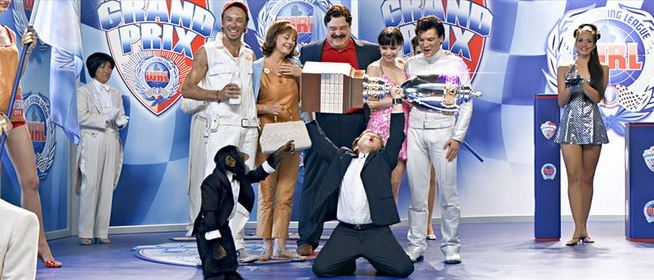
WINNERS' CIRCLE: Kick Gurry, Susan Sarandon, John Goodman, Christina Ricci and Emile Hirsch watch on as Paulie Litt and Chim Chim celebrate in Speed Racer. Image: Village Roadshow Pictures, Warner Brothers.

Directors: Larry Wachowski (now Lana Wachowski), Andy Wachowski

Writers: Larry Wachowski (now Lana Wachowski), Andy Wachowski, Tatsuo Yoshida (anime series Speed Racer)

Cast: Emile Hirsch, Christina Ricci, Matthew Fox, Susan Sarandon, John Goodman, Roger Allam, Rain, Benno Fürmann, Richard Roundtree, Paulie Litt, Kick Gurry, Hiroyuki Sanada, Nicholas Elia, Ariel Winter, Scott Porter, Kenzie and Willy the Chimpanzees

Producers: Larry Wachowski (now Lana Wachowski), Andy Wachowski, David Lane Seltzer, Joel Silver, Bruce Berman, Roberto Malerba, Michael Lambert, Jessica Alan, Marcus Loges, Charlie Woebcken, Grant Hill, Henning Molfenter

Cinematographer: David Tattersall (Director of Photography)

Original Music Composer: Michael Giacchino

Film Editors: Roger Barton, Zach Staenberg

Production: Owen Paterson (Production Designer), Anja Müller, Marco Bittner Rosser, Sebastian Krawinkel, Hugh Bateup (Art Directors), Peter Walpole (Set Decorator)

Costume Designer: Kym Barrett

Running Time: 2 hours and 15 minutes