 |
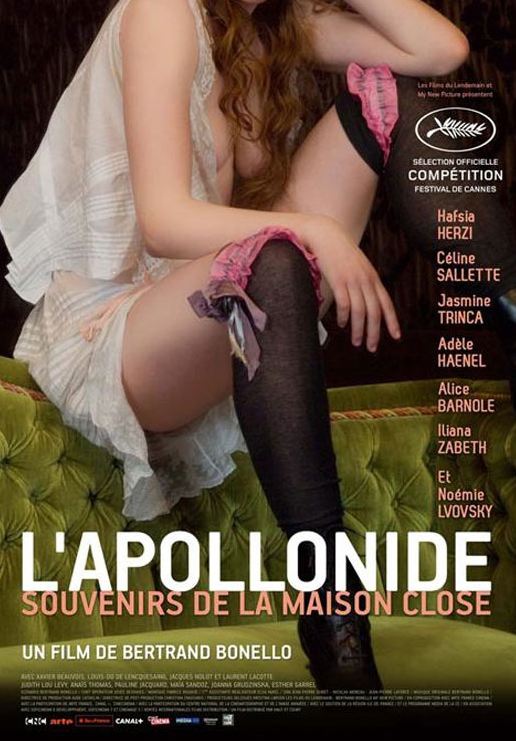
| French poster artwork for the drama film House Of Tolerance (L’apollonide- Souvenirs de la maison close). |
Parisian
Pleasures by Linh
House
of Tolerance, also known as House of Pleasures in Europe, is a visually sumptuous feast for the
eyes, filling the screen with the lavish interior of the brothel L’apollonide,
and the extravagant attire worn by the prostitutes. Behind all this façade of
beauty and elegance is the lonely and grim reality for the prostitutes; some
who have worked there for many years and feel trapped in a cycle of endless
poverty and degradation, have nowhere else to go and stay on to pay off their
“debts”.
 |
LOUNGE
LADIES: Madeleine (Alice Barnole), Léa (Adèle Haenel) and Julie
( (Jasmine Trinca) laze about in the sitting room in the film House Of Tolerance (L’apollonide- Souvenirs
de la maison close). Image: IFC Films, Rialto Distribution.
|
The French film opens in Paris of 1899, delving into the
lives of a group of young women prostitutes whose experiences of love, joy,
grief and pain is shared amongst themselves and hidden away from the public.
The prostitutes are seen as mere sexualised objects of pleasure and beauty by
their male clients, yet the viewer is also treated to life in the brothel from
the prostitutes’ perspective. Few films have attempted to show the prostitute’s
point of view. Many prostitutes have been depicted as profoundly mysterious
women in works of art and literature, because among the many who frequented the
Parisian brothels, a small number were usually artists and writers. The film
shows the male clientele as varying in ages but mostly coming from a background
of great influence, wealth and aristocratic society, and not many were artists
as they may not be able to afford the high prices of the L’apollonide.
 |
SENSUAL
SIREN: Pauline (Iliana Zabeth) poses for her male client like
the models in French paintings in the film House
Of Tolerance (L’apollonide- Souvenirs de la maison close). Image: IFC Films,
Rialto Distribution.
|
All the prostitutes have a story, yet some are given
greater weight than others. The most disturbing and horrifying is the incident
when the demure Madeleine (Alice Barnole) is brutually attacked and disfigured
by a regular male client who is a sadistic sociopath. There is the gorgeous and
bright Julie (Jasmine Trinca) who discovers she has the sexually transmitted
disease syphilis; the sixteen year old Pauline (Iliana Zabeth) is alluring and
talented, and is shown being doused with champagne in a bathtub by one client,
then dressed up as a geisha girl for another; the feisty Léa (Adèle Haenel) is
a skilled mime artist and “doll” impersonator whose exuberance keeps the other
girls upbeat. An interesting aspect of the characters is how all the
prostitutes look like they stepped out of a painting by Renoir, Monet or
Courbet, with the similar physical beauty as seen in the models used at the
time.
 |
WOMEN
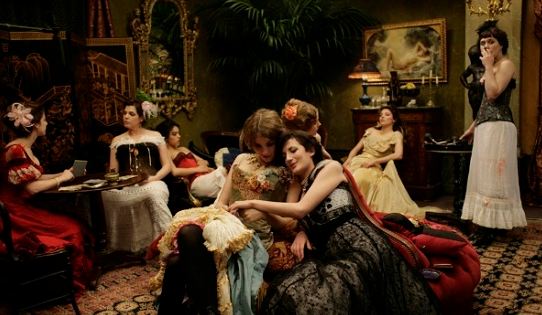
WHO WAIT: The prostitutes wait for clientele at the L'apollonide
brothel in Paris in the film House Of
Tolerance (L’apollonide- Souvenirs de la maison close). Image: IFC films, Rialto
Distribution.
|
Director Bertrand Bonello (The Pornographer, On War)
gives the audience an ‘up close and personal’ insight into how he imagined life
was like for prostitutes of upscale Parisian brothels in the late nineteenth
century and early twentieth century. Some scenes in the film look like music
videos, and is not surprising as Bonello was originally a musician who entered
the world of cinema via music. He uses classical music and some contemporary
rock music as the film’s narrative moves from late nineteenth century to the
twentieth century, signalling the end of an era for the brothel business in Paris.
Cinematographer Josée Deshaies beautifully captures the
action inside the bedrooms, along the brothel corridors and as the girls lay
about in the sitting room waiting for clients to arrive. There are very few
external scenes with most of the film shot inside the confines of the brothel
to give the viewer a sense of being “trapped” which reflects that of the
prostitutes. The prostitutes have no contact with the outside world, other than
through their male clients. There is one memorable outdoor scene in which all
the girls have a “day off” to go picnicking, swimming in the lake, and relaxing
by the lake gossiping about certain clients. Almost every frame in the film
looks like a French painting and the colours range from bright and vibrant to
dark or earthy, yet still beautifully filmed.
House
Of Tolerance engages the viewer through its visual beauty
and the fine performances. As the brothel business crumbles in Paris, the lives
of the prostitutes deteriorate. This may be a metaphor signalling change and
renewal politically, socially and economically for France in 1900 or for women’s
rights in French society.
House
Of Tolerance (L’apollonide- Souvenirs de la maison close). G-Rated Film Trailer (courtesy of IFC
Films):
Director:
Bertrand Bonello
Writer: Bertrand
Bonello (screenplay)
Cast:
Adèle Haenel, Hafsia Herzi, Jasmine Trinca, Céline Salette, Noémie Lvovsky,
Alice Barnole, Esther Garrel, Jacques Nolot, Iliana Zabeth, Joanna Grudzinska,
Louis-Do de Lencquesaing, Xavier Beauvois, Laurent Lacotte
Producers: Kristina
Larsen, Bertrand Bonello
Original
Music Composer: Bertrand Bonello
Cinematographer: Josée
Deshaies
Film
Editor: Fabrice Rouaud
Production
Designer: Alain Guffroy
Costume
Designer: Anaïs Romand
Language:
French with English subtitles
Running
Time: 2 hours