|
| French film poster artwork for the romantic comedy film Populaire. |
Pastiche Pygmalion Parody by Linh
Populaire is a delightful and charming rom-com (romantic comedy) that only the French can create without the predictability and spoon-feeding aspects of this genre that are often seen in most American contemporary rom-com films. An impressive aspect of this film is the blending of pastiche in imitating the era of the 1950s and the parody of the Pygmalion myth. Populaire uses various references from the American television series Mad Men and the light-hearted American rom-com films of the 1950s such as the style of dress and the attitudes regarding gender roles and expectations. In parodying the Pygmalion myth, Populaire cleverly uses humour and characterisation to depict the “coming to life or awakening” of an independent and strong-willed woman under the guidance of a competitive and suave man.
 |
| WORKPLACE WINNER: Rose (Déborah François) excels in all secretarial tasks for her boss Louis (Romain Duris) in the romantic comedy film Populaire. Image: Wild Bunch, The Weinstein Company. |
Populaire is set during 1958-1959 in the small town of Normandy in France, where a young woman named Rose Pamphyle (Déborah François), who lives with her widowed father Jean (Frédéric Pierrot), is soon to be engaged to the local mechanic’s son. Rose is adamant she will not marry and plans to seek a job instead. One day she takes the typewriter in her father’s shop, inserts a sheet of paper and types her name using her two index fingers. A few months later, Rose travels to Lisieux to apply for a job as a secretary at Echard and Sons Insurance company, where she meets the owner Louis Echard (Romain Duris). He dismisses her based on lack of experience, but she promptly shows him she has speed and accuracy in typing despite using only her two index fingers. Louis is impressed and strikes a deal with Rose that he will only employ her if she agrees to compete in a series of speed typing competitions. Rose agrees to Louis’s terms and conditions in order to get the job as secretary, resulting in humourous moments including speed and touch typing training using all her fingers, physical training sessions, piano playing with Marie (Bérénice Bejo) to keep her fingers flexible and an unexpected meeting with Louis’s family.
 |
| TENACIOUS TYPIST: Louis (Romain Duris) times Rose (Déborah François) as she practises her speed typing in the romantic comedy film Populaire. Image: Wild Bunch, The Weinstein Company. |
A study of the film’s poster design gives hints at the themes and metaphors present in Populaire that relate to gender and competition. Regarding gender in the workplace, Rose is standing behind Louis which suggests that the secret behind a businessman’s success is his secretary. In the film, Louis was a former boxer and athlete who was unable to achieve national and international success and is haunted by his days as a member of the French Resistance during World War II. With his strict regimental training for Rose to win speed typing competitions, he can share in her success and experience the sense of being a champion again.
Another gender-related reading of this poster is the positioning of subjects/objects in the frame; the typewriter represents female success and independence in the workplace yet there is a man between it and the female typist. This may suggest that the only thing that stands between a woman and her pathway upwards to success in the workplace is misogyny or sexism, as the male is seen as representing patriarchy.
 |
| TWO-FINGERED TYPIST: Rose (Déborah François) competes for the first time in the local speed typing competition in the romantic comedy film Populaire. Image: Wild Bunch, The Weinstein Company. |
The pastiche of Populaire closely resembles the set, wardrobe and era of the television series Mad Men, particularly in the office scenes depicting Louis and Rose at work and in training for the speed typing competitions. The gender politics in Populaire become apparent in the parodying of the Pygmalion myth adapted from a play by George Bernard Shaw whereby, instead of polishing up on the spoken word, Rose is required to speed up the written word using a typewriter. Therefore, Rose is transformed into a modern working woman through training to be a super-fast typist who gains the adoration of the public and respect from Louis. The typewriter is a central character in the film, as it is seen in almost every scene, mostly as a supporting character to the typist.
 |
| SPORTING STAMINA: Louis (Romain Duris) trains Rose (Déborah François) to develop strength and stamina as part of her speed typing training in the romantic comedy film Populaire. Image: Wild Bunch, The Weinstein Company. |
Typists were typically female with secretaries being one of the highest paid and sought-after jobs for women in the post-war era, however the film depicts typing as not only for work but also as a sport. This is a contentious aspect of the film suggesting that not only do women compete against other women for a man, they also compete against other women for work and in sport. Some critics may argue that men also compete with other men in love, work and sport so what is the issue? The issue is that in a patriarchy society, women are not only competing with other women, they are competing in male-dominated and male-controlled arenas. In the film, every aspect of Rose’s typing training and work schedule is controlled by her boss Louis. Rose is not given any opportunities to contribute ideas or suggestions. In the competition arena, Rose may be competing with other women, but it also an arena controlled by men. Populaire cleverly uses metaphors to parody and modernise Bernard Shaw’s Pygmalion depicting gender bias in the workplace, which is still prevalent in the twenty first century.
 |
| FLEXIBLE FINGERS: Marie (Bérénice Bejo) teaches Rose (Déborah François) to play the piano to help keep her fingers supple for speed typing competitions in the romantic comedy film Populaire. Image: Wild Bunch, The Weinstein Company. |
The cast for Populaire is excellent and Déborah François (The Page Turner, Maestro) is brilliant as Rose in her transformation from a shy, small-town and two-finger typist to an international speed typing winner; Romain Duris (Mood Indigo, Chinese Puzzle) is smooth talking and suave as the male chauvinist boss Louis wearing similar style business attire as Don Draper from Mad Men; Bérénice Bejo (The Artist, The Past) is lovely as Marie Taylor, who looks glamourous and seductive even as a housewife who teaches piano in her home. She is Louis’s former lover who married his best friend Bob due to Louis’s lack of commitment to their relationship; Shaun Benson (The Metrosexual, Le Beau Risque) is delightful as Bob Taylor, the comic relief and Louis’s best friend who takes a keen interest in Louis’s plan to train Rose for competitions.
 |
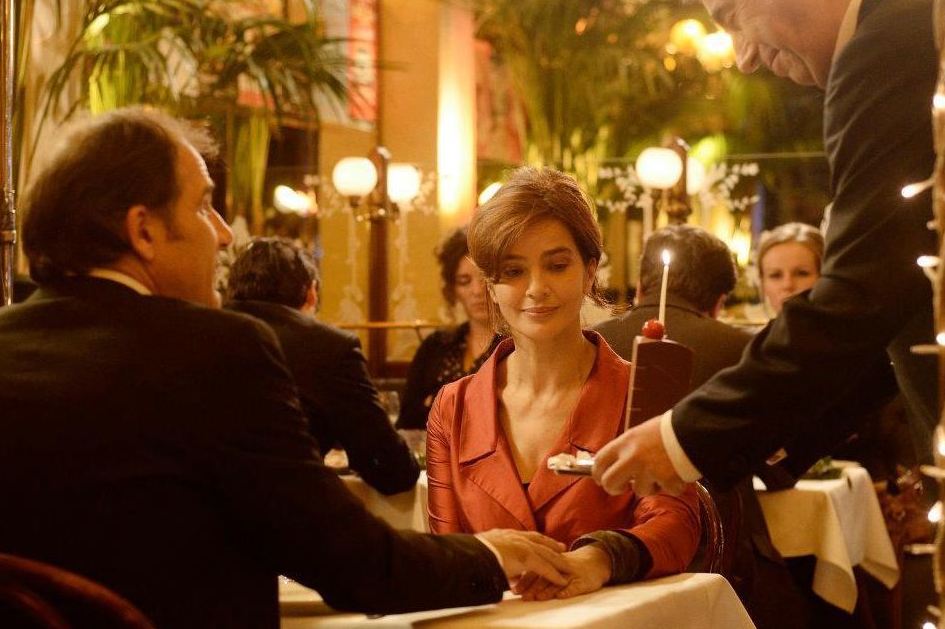
| WINNERS WALTZ:
Louis (Romain Duris) and Rose (Déborah François) dance at a dinner party
after a successful day at the local speed typing trials in the romantic comedy film Populaire. Image: Wild Bunch, The Weinstein Company. |
Populaire is a sparkling romantic comedy gem that appeals to those who enjoy gender issues served up in a light-hearted manner as only French rom-com films can deliver. The brightly coloured production designs, the retro clothing, hairstyles and the wonderful performances make this film a nostalgic look at the past that reminds viewers how women have progressed and achieved so much since the 1950s, albeit with a little help from some men and technology.
Director: Régis Roinsard
Writers: Régis Roinsard, Romain Compingt, Daniel Presley
Cast: Romain Duris, Déborah François, Bérénice Bejo, Shaun Benson, Mélanie Bernier, Féodor Atkine, Nicholas Bedos, Eddy Mitchell, Miou- Miou, Jeanne Cohendy, Caroline Tillette, Frédéric Pierrot, Marius Colucci, Emeline Bayart, Yannik Landrein, Natassja Girard, Dominique Reymond, Hugo De Sousa
Producers: Gaëtan David, Alain Attal, André Logie, Xavier Amblard
Original Music Composer: Emmanuel D’Orlando, Robin Coudert
Cinematographer: Guillaume Schiffman
Film Editors: Sophie Reine, Laure Gardette
Production: Sylvie Olivé (Production Designer), Jimena Esteve (Set Decorator)
Costume Designer: Charlotte David
Languages: French, English and German with English subtitles
Running Time: 1 hour and 50 minutes