Showing posts with label Friedemann Fromm. Show all posts

Sunday, 23 June 2013

The Wolves of Berlin/Die Wölfe: Hope for Happiness (2009), review


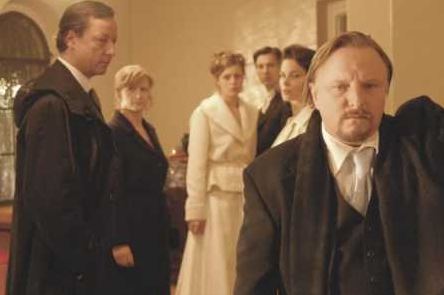
WEDDING WORRIES: Jakob (Matthias Brandt), Silke (Johanna Gastdorf), Miriam (Alma Leiberg), Thomas (Florian David Fitz), Lotte (Barbara Auer), Bernd (Axel Prahl) feel awkward after not seeing each other for over twenty years in the telemovie The Wolves of Berlin (Die Wölfe).Image: ZDF / Claudia Terjung.

The final part of The Wolves of Berlin (Die Wölfe) called Hope for Happiness, is set in 1989, the year the Berlin Wall was destroyed to re-unite a divided Germany. The six friends have become five, following Ralf’s tragic death in the previous telemovie.The final chapter opens in East Berlin, with Jakob, now aged in his fifties and using the name Johann, after being employed by the East German government to create computer software to spy on the West. He is married to the ever feisty Silke, and they have two sons named Thomas and Martin. Martin has enlisted in military school and has said he would shoot at anyone if ordered by his superiors, including his loved ones, but Thomas is attending university and growing increasingly bored.

Meanwhile in West Berlin, Lotte is married to Bernd and has become a piano and voice teacher. She still believes her former lover Jakob is dead and blames Silke for her loss. She and Bernd have two children, a lovely and free-spirited daughter named Miriam and a younger son named Oliver. Oliver is still a child, but university student Miriam has plans to become a singer-songwriter.

Bernd, Lotte, Jakob and Silke have not been in contact with each other for the last twenty years, but Kurt and his wife Eva still visit Bernd and Lotte on many occasions. Thomas and Miriam cross paths during a trip to Hungary in the Summer of 1989 and fall in love, amidst the droves of East Germans fleeing the country and openly protesting against the East German regime. Their romance continues as Hungary opens its borders enabling more people to flee from East Berlin, and Thomas finds Miriam then proposes. Much to Thomas’ surprise, Miriam reveals she is pregnant with his child and decides to keep the baby. At this stage, neither Thomas nor Miriam realise their parents were once members of a friendship pact and have an ongoing feud. Thomas and Miriam’s marriage coincides with the downfall of the Berlin Wall, and metaphorically signifies the end of the misunderstandings between The Wolves after more than twenty years apart. However, not all is well between Bernd and Jakob.

This final chapter signals not only the end of the Berlin Wall, but also the beginning of a unified Germany after years of political and social reforms that took its toll on the people. This parallels with the friendship of The Wolves who have experienced much turbulence and turmoil throughout their lives and they must now re-group to start a new alliance as not only friends, but also as a family, following their children’s marriage.

Director: Friedemann Fromm

Writers: Friedemann Fromm (screenplay), Christoph Fromm (screenplay)

Cast: Axel Prahl, Matthias Brandt, Felix Vörtler, Barbara Auer, Johanna Gastdorf, Florian David Fitz, Alma Leiberg, Marc Bennert, Max Woelky, Helene Grass, Robert Frank, Gerdy Zint, Angelika Gersdorf

Producers: Regina Ziegler, Marianna Rowinska

Original Music Composer: Edward J. Harris

Cinematographer: Hanno Lentz 
            
Language: German with English subtitles

Running Time: 1 hour and 30 minutes

The Wolves of Berlin/Die Wölfe Part Two: A Broken City (2009); review

CLOSE CLIQUE: The Wolves, Kurt (Aljoscha Stadelmann), Bernd (Florian Lukas) Ralf (Constantin von Jascheroff), Jakob (Florian Stetter), Silke (Stefanie Stappenbeck) and Lotte (Annett Renneberg) celebrate their thirteenth anniversary together in 1961 in the telemovie The Wolves of Berlin (Die Wölfe). Image: ZDF / Claudia Terjung.

A Broken City is part two of The Wolves of Berlin (Die Wölfe) and is set in 1961, where Berlin is no longer in four sectors, following the creation of the Federal Republic of Germany (West Germany) and the German Democratic Republic (East Germany) in 1949. It was also the end of the Berlin Airlifts and the various blockades. The Wolves are now twenty-something adults, with a renewed sense of hope for their futures, despite the dangers of crossing between borders.

WILD WOLF: Bernd (Florian Lukas) is the leader and most aggressive of The Wolves in the telemovie The Wolves of Berlin (Die Wölfe). Image: ZDF / Claudia Terjung.

Bernd who now lives in West Berlin, owns and runs a successful transport company, with Lotte’s younger brother Ralf (who lives in East Berlin) as his right-hand man. Lotte is now an up-and-coming singer living in East Berlin, and is still in love with Jakob, despite considering Bernd’s marriage proposal. Jakob is a talented Maths professor and computer analyst teaching at a university in East Berlin, and is still keen on Lotte. Silke is also living in East Berlin, and is working as a reporter for a local television station, but has turned into a politically active Socialist. Kurt lives in West Berlin and has been elected as a local politician with strong links to people who can help him cross the border.

LOVABLE LOTTE: Lotte is the 'target' for Bernd's affections and the unrequited lover of Jakob in the telemovie The Wolves of Berlin (Die Wölfe). Image: ZDF / Claudia Terjung.

The Wolves continue to socialise and communicate regardless of the strict border controls between East and West Berlin, until the communistic East-German authorities quickly and stealthily put up the Berlin Wall overnight. It is a swift response from the East German authorities, who fear too many people are leaving the repressive communist East for the more democratic life in West Germany. This situation poses a threat to the friendships and connections between members of The Wolves, so Bernd devises a plan to reunite all six in West Berlin, which leads to tragedy. After the failed border-crossing attempt, Jakob is captured by the East German State Police, commonly known as the Stasi, and offered a deal to become a spy for them.

DANGEROUS DIVISION: Bernd (Florian Lukas) and Ralf (Constantin von Jascheroff) agree to plans in crossing the border between East and West Berlin in the telemovie The Wolves of Berlin (Die Wölfe). Image: ZDF / Claudia Terjung.

Archival footage from 1961 is shown throughout the film, and news broadcasts are used to depict the changes occurring in East and West Germany at the time. Director Friedemann Fromm continues to inform and educate contemporary audiences about the political upheaval and impact of social changes on the daily lives of Berliners in 1961, while maintaining a clear narrative where the political/social/economic reforms reflect the changes in the characters’ lives. The American influences of the 1960s in Germany also feature in the film, as in the scene where Lotte sings many standard American jazz songs such as 'Night and Day' and 'Fly Me To The Moon' in English. 

COLLABORATIVE CONCERNS: (Stefanie Stappenbeck) and Lotte (Annett Renneberg) want The Wolves to stay together but worry about the dangers involved in crossing the borders in the telemovie The Wolves of Berlin (Die Wölfe). Image: ZDF / Claudia Terjung.
 
The strong ensemble cast is led by Florian Lukas, resembling a youthful Liam Neeson, as the quick-witted but hot-headed Bernd in a solid performance; handsome Florian Stetter, is excellent as the go-getter and hardworking Jakob; Lotte is played by the lovely Annett Renneberg, whose voice is delicate in its high notes but deeper and richer in lower tones; Silke is wonderfully played by popular actress in Germany, Stefanie Stappenbeck, whose character is the strong voice of the socialist movement in East Berlin; Aljoscha Stadelmann is the kind and good-natured Kurt, who uses his political connections to help Bernd organise a clear path in his border-crossing attempt.
This is the best of the three parts in The Wolves of Berlin (Die Wölfe), with plenty of action, drama, tragedy and romance as the six friends struggle to stay together in a divided country.

Director: Friedemann Fromm

Writers: Friedemann Fromm (screenplay), Christoph Fromm (screenplay)

Cast: Florian Lukas, Florian Stetter, Aljoscha Stadelmann, Annett Renneberg, Stefanie Stappenbeck, Constantin von Jascheroff, Marko Bräutigam, Sven Lehmann, Atto Suttarp, Michael Niekammer, Ralf Tempel, Angelika Gersdorf, Anna Stieblich

Producers: Regina Ziegler, Marianna Rowinska

Original Music Composer: Edward J. Harris

Cinematographer: Hanno Lentz
            
Languages: German with English subtitles and English

Running Time: 1 hour and 30 minutes

The Wolves of Berlin/Die Wölfe Part One: Nothing Can Separate Us (2009); drama review


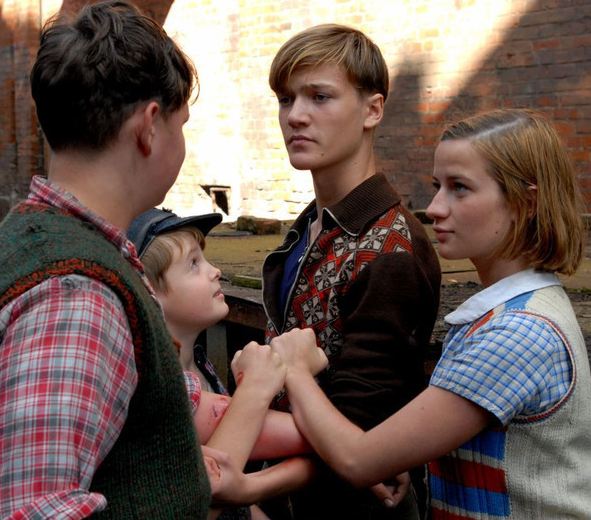
WONDER WOLVES: In Berlin 1948, Ralf (Maximilian Werner), Silke (Nina Gummich) Jakob (Neel Fehler), Lotte (Henriette Confurius) Bernd (Vincent Redetzki) and Kurt (Philip Wiegratz) form The Wolves in the telemovie The Wolves of Berlin (Die Wölfe). Image: ZDF / Claudia Terjung.

Powerful Pact by Linh

The Wolves of Berlin (Die Wölfe) is a three part telemovie that screened in Germany in 2009 as part of the twentieth anniversary of the destruction of the Berlin Wall. The telemovie depicts the lives, tribulations and loves of six young people during 1948, 1961 and 1989. These three years bear historical significance to Germany’s political and social changes, and the six teenagers’ opinions, influences and attitudes become shaped by the events that occur during these years.

Director and screenwriter Friedemann Fromm has used black and white archival footage from the three years firstly as a backdrop to the personal dramas of the characters’ lives, blending the monochrome of the past with the colour of the present. Gradually as the teens mature throughout the years, he intertwines news footage and media coverage to directly impact on all six lives.

Part one of The Wolves of Berlin (Die Wölfe), titled Nothing Can Separate Us, opens with the six friends now aged in their fifties and attending the wedding of their children. There is tension between two of the friends and it leads to a lengthy flashback sequence beginning with the six friends as teenagers in Berlin. The six teenagers, who all live in Berlin, form a lifetime friendship pact named The Wolves. The film’s title is their slogan “Nothing can separate us. Not even Death” and comes from the poster of a film which was screening in their local theatre in 1948.

FRIENDS FOREVER: Kurt (Philip Wiegratz), Ralf (Maximilian Werner), Bernd (Vincent Redetzki) and Silke (Nina Gummich) reaffirm their eternal friendship in the telemovie The Wolves of Berlin (Die Wölfe). Image: ZDF / Claudia Terjung.

The Wolves consists of Bernd, Kurt, Jakob, Lotte, Silke and Ralph. Bernd lives with his mother, and has wild and ambitious plans to open his own bar and shout his friends free beer every night. His good friend, the tubby and affable Kurt, who lives with his mother and war veteran father, is keen to help Bernd and becomes the glue that keeps everyone together in The Wolves. In the same neighbourhood, flirtatious and politically active Silke also becomes part of the pact. Lotte, an aspiring singer and her younger brother Ralf also join, despite Lotte already dating a boy from a rival group. Jakob, a Jewish boy who survived the trauma of the concentration camps is the last to join, and Bernd is instantly suspicious of him as he and Jakob compete for Lotte’s attention.

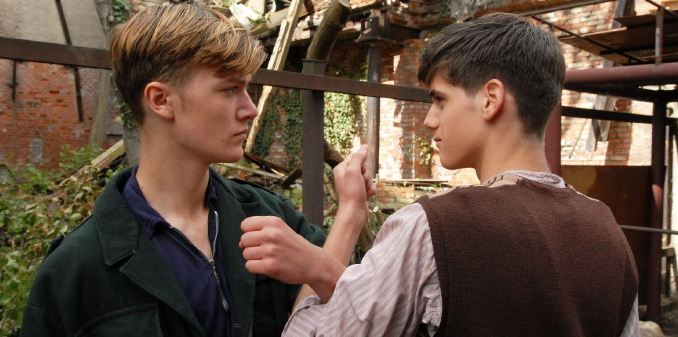
BROTHERLY BONDS: Bernd (Vincent Redetzki) lets Jakob (Neel Fehler) join The Wolves despite disliking him in the telemovie The Wolves of Berlin (Die Wölfe). Image: ZDF / Claudia Terjung.

Set in 1948 Berlin, the country is divided into four sectors, Russian, British, French and American. The sectors are cut off by blockades and barb wires, and strict curfews and blackouts are enforced as a means of controlling movement of people within and outside the sectors. The Wolves are cunning and find ways to move freely without being noticed, and one scene shows Lotte smuggling in supplies from one sector to the next.

The Berlin Airlifts also features in the film, where Ralf keenly observes and looks out through his binoculars for US aeroplanes that drop supplies for the people of Berlin. Ralf and the rest of The Wolves then scramble as fast as they can to get as much as they could carry before the soldiers catch them.

The currency reform in 1948 further divided Berlin, with two different currencies in two different zones. Bernd, Kurt and Silke found creative ways to make money, through bartering, exchanging or seduction. Jakob is a clever pick-pocket with a quick hand and sly smile, Lotte attempts to sing for her supper and young Ralf is a talented little Mr. Fix-it.

SCAVENGING SUPPLIES: Bernd (Vincent Redetzki) and Jakob (Neel Fehler) risk their lives while grabbing food from the downed airlift planes in the telemovie The Wolves of Berlin (Die Wölfe). Image: ZDF / Claudia Terjung.

The young cast is engaging and convincing with Vincent Redetzki who is wonderful as the head of The Wolves with a strong killer instinct; Philip Wiegratz, who is best remembered as the always-hungry Augustus Gloop in Tim Burton’s film adaptation Charlie and the Chocolate Factory is comical as the tubby Kurt; Henriette Confurius is gorgeous and has a lovely singing voice as the aspiring singer Lotte; Neel Fehler gives his character, Jakob, a silent and powerful inner strength and Nina Gummich is delightfully playful as the intelligent and feisty Silke.

As Berlin continues to be carved up by political reforms and suffering from economic decline, The Wolves do everything they can to stay together, defending themselves against rival gangs, resisting the influence of Socialism and the repression of Communism, protecting and supporting each other.

BARBED-WIRE BORDER: Soldiers guarding the borders in the telemovie The Wolves of Berlin (Die Wölfe). Image: ZDF / Claudia Terjung.

Director: Friedemann Fromm

Writers: Friedemann Fromm (screenplay), Christoph Fromm (screenplay)

Cast: Vincent Redetzki, Philip Wiegratz , Neel Fehler, Henriette Confurius, Nina Gummich, Maximilian Werner, Florian Panzner, Daniel White, Sven Lehmann, Martin Klemrath , Christian Kerepeszki, Angelika Gersdorf, Kai Holzapfel

Producers: Regina Ziegler, Marianna Rowinska

Original Music Composer: Edward J. Harris

Cinematographer: Hanno Lentz
Languages: German with English subtitles and English

Running Time: 1 hour and 30 minutes